
Workload and Collective Bargaining

In a process similar to one being played out across campus the Head in my home department brought a workload policy to a recent department meeting. The document was newly crafted, but introduced as more like an executive summary of existing policies. It was restricted to statements on teaching and service. Feedback was solicited. We were advised that this document would work its way to the Dean’s Office and then to Faculty Relations.
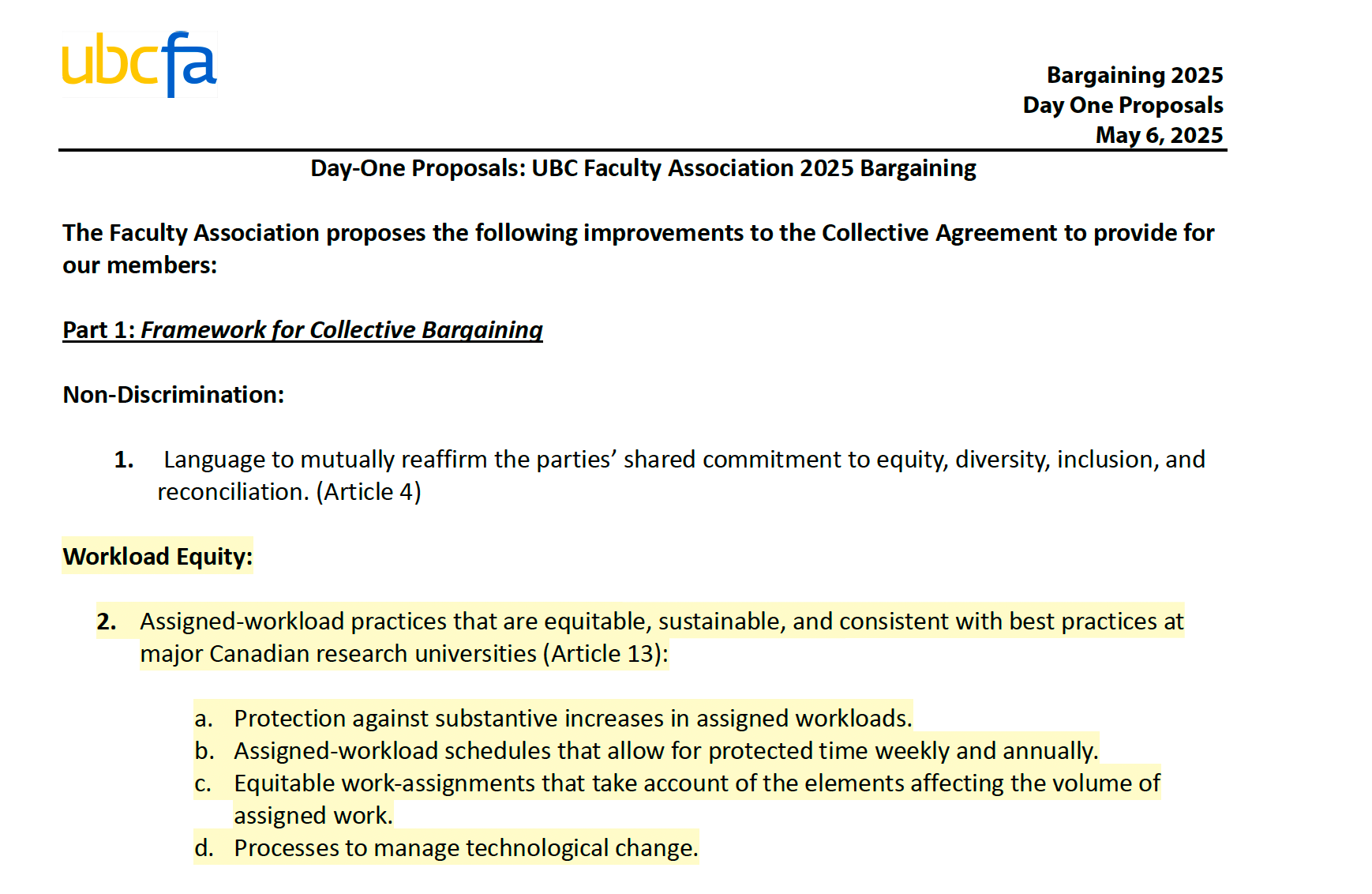
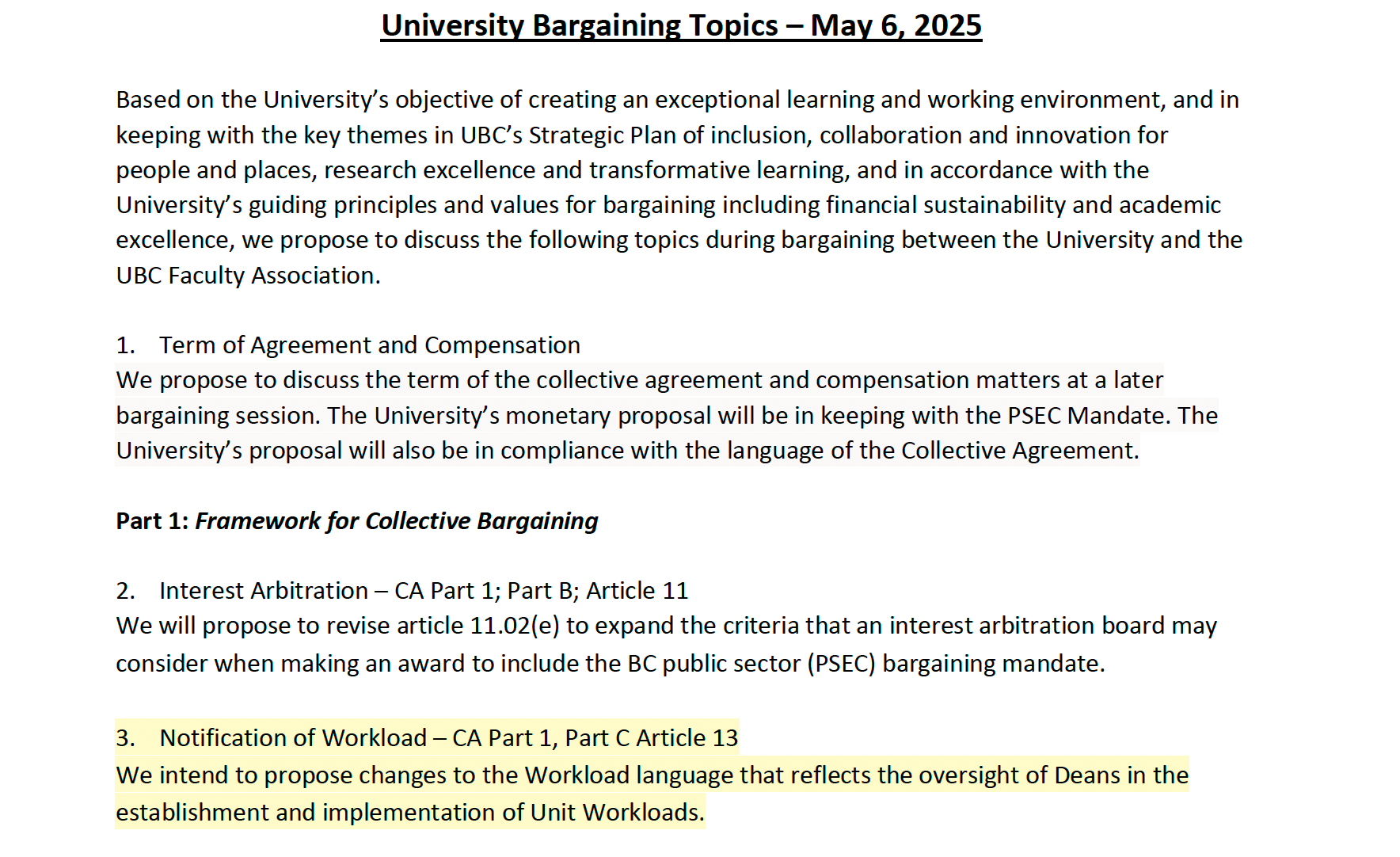
The current concern is tied to collective barging now underway. UBC’s Faculty Association is seeking greater equity in setting workloads. UBC’s Management wants the Dean’s managerial role codified. Both parties are seeking changes and clarifications.
Codifying Workload
For more than a decade UBC’s Faculty Association has pushed management on workload issues. It was an issue when I was first elected a member-at-large on the FA Executive in the early 2000s. It’s still an issue today. The ongoing university expectation that faculty work until their work is done without regard for how long that takes is one of the underlying sources of stress and poor wellbeing. It is also something that sparks interpersonal conflict in the workplace due to acts of overt or perceived administrative favouritism and/or discrimination. Over time the FA & UBC have negotiated contract clauses that require units to establish workload guidelines. Yet problems persist.
A core issue is the contradictory way we evaluate our work. Teaching and service are essentially measured by input, research by output. Combined with the informal (if not explicit) bias toward research output the contradictory methods of workload assessment sets the stage for a struggle over allocation of teaching and service assignments as these are seen as impediments toward success in research. Faculty are incentivized to minimize the impacts of teaching and service on their capacity to produce research outputs.
Teaching involves a range of courses. Large enrolment courses that includes managing teaching assistants as well as instructional duties. Small seminar courses for senior undergrads or graduate students. Then we have an array of lecture, seminar, and lab courses with in between enrolments. Departments often have an expectation that on average (in the social sciences at any rate) we teach between 175 to 250 students per year. Most units include graduate supervision and graduate committee membership under teaching. Some include considerations of undergraduate honours and post-doc supervision. All of this is framed in terms of how much time it takes to prepare and manage the teaching process. Teaching is considered 40% of of work.
Service is essentially the administrative side of our work: department work like curriculum management, student advising, review of colleagues in P&T processes and on hiring committees among other things. Service, like teaching, is seen in terms of time commitments. The labour time of some types of department and university service is acknowledged by granting teaching release. Service is considered 20% of our work.
Research is evaluated by a completely different scale. Here it is acknowledged in terms of output, not time invested. So while research is deemed to be 40% of our workload it is in fact often the major time commitment of our days. This can lead to conflicts in our personal allocating of time and in our meeting of familial and social obligations outside of work. It can be a totalizing situation.
One counter to this is slow scholarship. This is an approach, like the slow food movement, that values the artisanal qualities of place and the nuance in taste that taking time grants our creative efforts. Slow scholarship is framed by some as a backlash against the neo-liberal university of excellence. In the drive to survive a workplace that knows no finite limit to research output the health and wellbeing of faculty and their significant others is ground down.
It’s hard to counter the dynamic of constant growth. Slow growth tries.
“Slow Scholarship” is a response to hasty scholarship. Slow scholarship, is thoughtful, reflective, and the product of rumination – a kind of field testing against other ideas. It is carefully prepared, with fresh ideas, local when possible, and is best enjoyed leisurely, on one’s own or as part of a dialogue around a table with friends, family and colleagues. Like food, it often goes better with wine (John Lutz, U.Vic.).
Slow scholarship might work for some, but in a infinite output workplace driven by the demands to keep expanding, accumulating, and growing, slow scholarships runs the risk of being an idiosyncratic act of defeatism.
One alternative strategy shared by Benoit Bacon when he was Dean of Arts and Sciences at Bishop’s University involves a “two-speed approach:”
I see more and more scientists resolving the issue by having a two-speed research program: a safer and more productive research program that will guarantee the renewal of their research funding, and in parallel, a slower, more thoughtful, quality-focused approach where they can do their best work over long periods of time.
Neither of these approaches directly addresses the fundamental structural context that compels faculty to sink all available time into research or end up feeling -or being labeled- a failure. Bacon’s two speed approach makes sense as an individual response to an untenable situation, it makes sense as good advice to early career scholars (advice I concur with), yet it doesn’t really help in the long run.
We need provisions in our collective agreement that places practical, functional, and finite limits on the drive toward over production. We need to move toward a balanced concept of reasonable, not maximal, research outputs. We need to reconceptualize reward systems in order to move away from soul deforming modes of competition. We need to find mechanisms to reward cooperation. Ultimately we need to ground ourselves in relationships of care and empathy